01 Selected work · Case study 01 of 04

Pricing a subscription
nobody has bought yet
A price-sensitivity study for Algo Research's first paid product. It recommends a launch price and a student rate, which Algo is still weighing up.
Overview
Algo's Exclusive Research drew three to five times the views of its other articles. It was free, and Algo had no way to earn from it.
Algo is an Indonesian financial-media start-up, founded in 2023 and fully bootstrapped. Its readership was growing fast, and clicks on Exclusive Research previews rose from 5.5% to 8.5%, but running costs had no revenue to cover them.
Solution
A proposed paid tier for Exclusive Research, with a launch price and a student rate based on what readers said they would pay.
Under the proposal, Market Insights and the newsletter stay free and Exclusive Research moves behind a paywall. Algo hasn't launched it yet: the pricing is the starting point for that decision, not a finished rollout.
I prototyped how the subscription could work on Algo's site if it goes ahead.
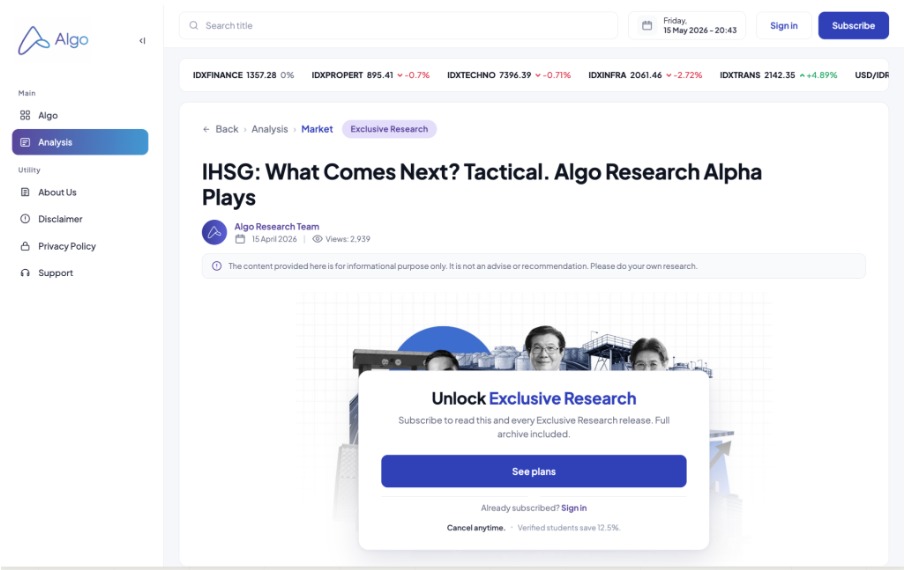
A locked article shows a preview and one clear next step.
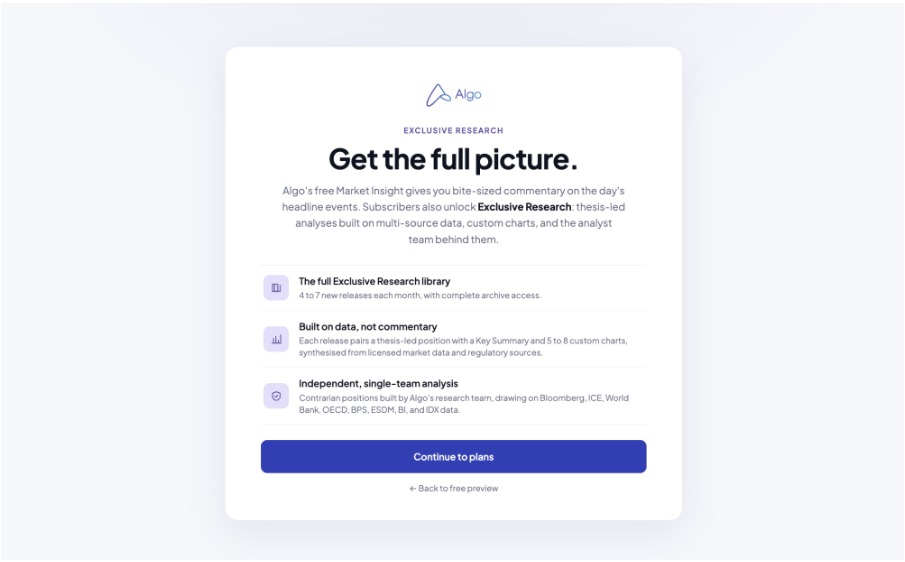
Before the price, a short page on what the free tier doesn't include.
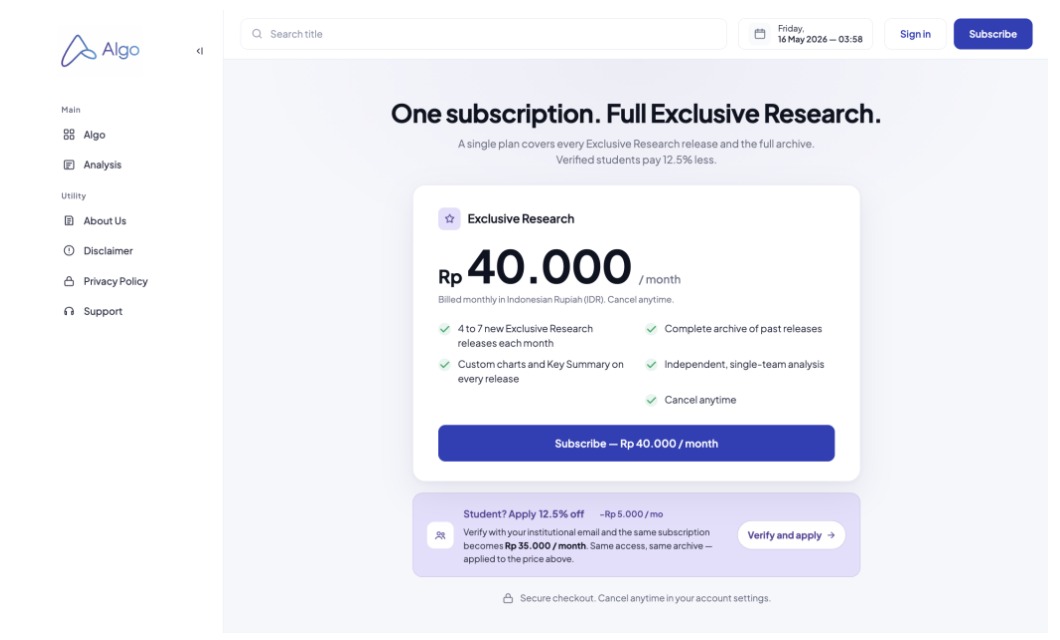
One plan at Rp 40,000, with the student rate one click away.
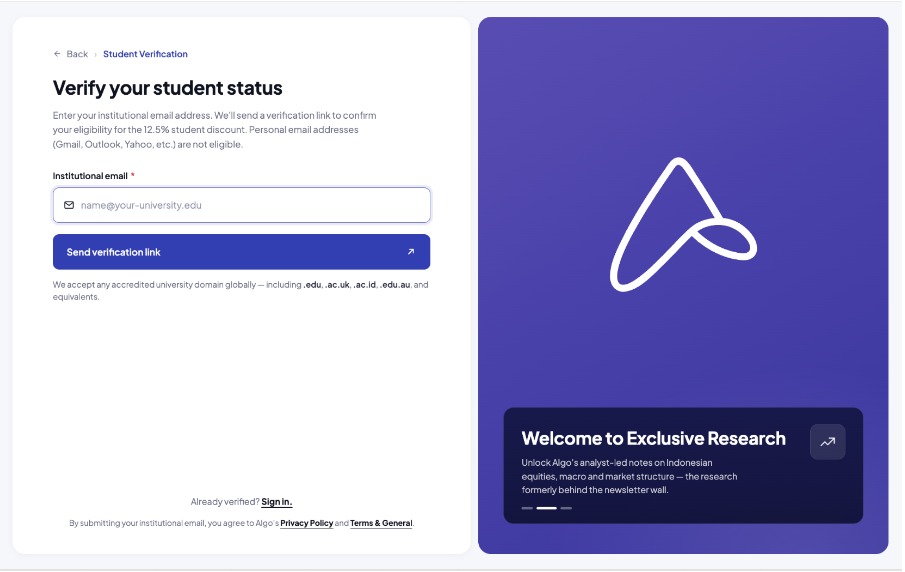
Students verify with a university email to get Rp 35,000.
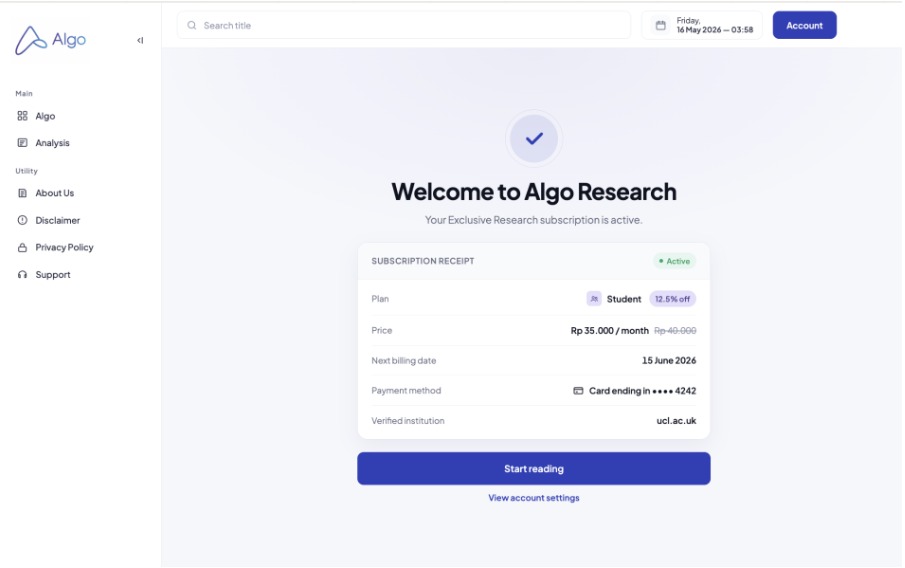
A receipt that shows the saving, then straight back to reading.
How I did it
- Research design. I proposed a Van Westendorp Price Sensitivity Meter (PSM) with the Newton-Miller-Smith (NMS) extension. PSM asks four price questions (too cheap, cheap, expensive, too expensive) to find the range readers would accept for a product that doesn't exist yet. NMS adds a likelihood-to-subscribe question at the cheap and expensive prices, which turns that range into demand and revenue curves.
- Why quantitative. Price thresholds only mean something as standardised numbers that can be compared across subgroups, which interviews and focus groups can't give reliably. I chose one cross-sectional online survey over mixed methods, because qualitative depth wouldn't have made the price estimate any better.
- Pilot. I tested the survey with 17 readers. It showed that a yes/no "would you pay?" gate screened out the price-sensitive readers and would have pushed every threshold up, so I removed it. I also added instructions for entering numbers and moved the survey to Google Forms so it ran inside Algo's workspace.
- Fieldwork. I sent it to all 3,802 newsletter subscribers for four weeks, with two reminders and no incentive. 453 replied, and 422 were valid after removing 5 non-consents and 26 answers with prices in the wrong order.
- Analysis. I plotted the PSM price points and NMS curves, split the results by engagement, employment status and age (subgroups of 30 or more), and checked each candidate price against five Indonesian content-led competitors.
Outcomes
- Recommended launch price per month
- Rp 40k
- Proposed verified-student rate
- Rp 35k
- Newsletter conversion to break even
- 13.2–15.1%
Initial findings
Readers valued the research above what the market charged. How engaged they were mattered more than who they were.
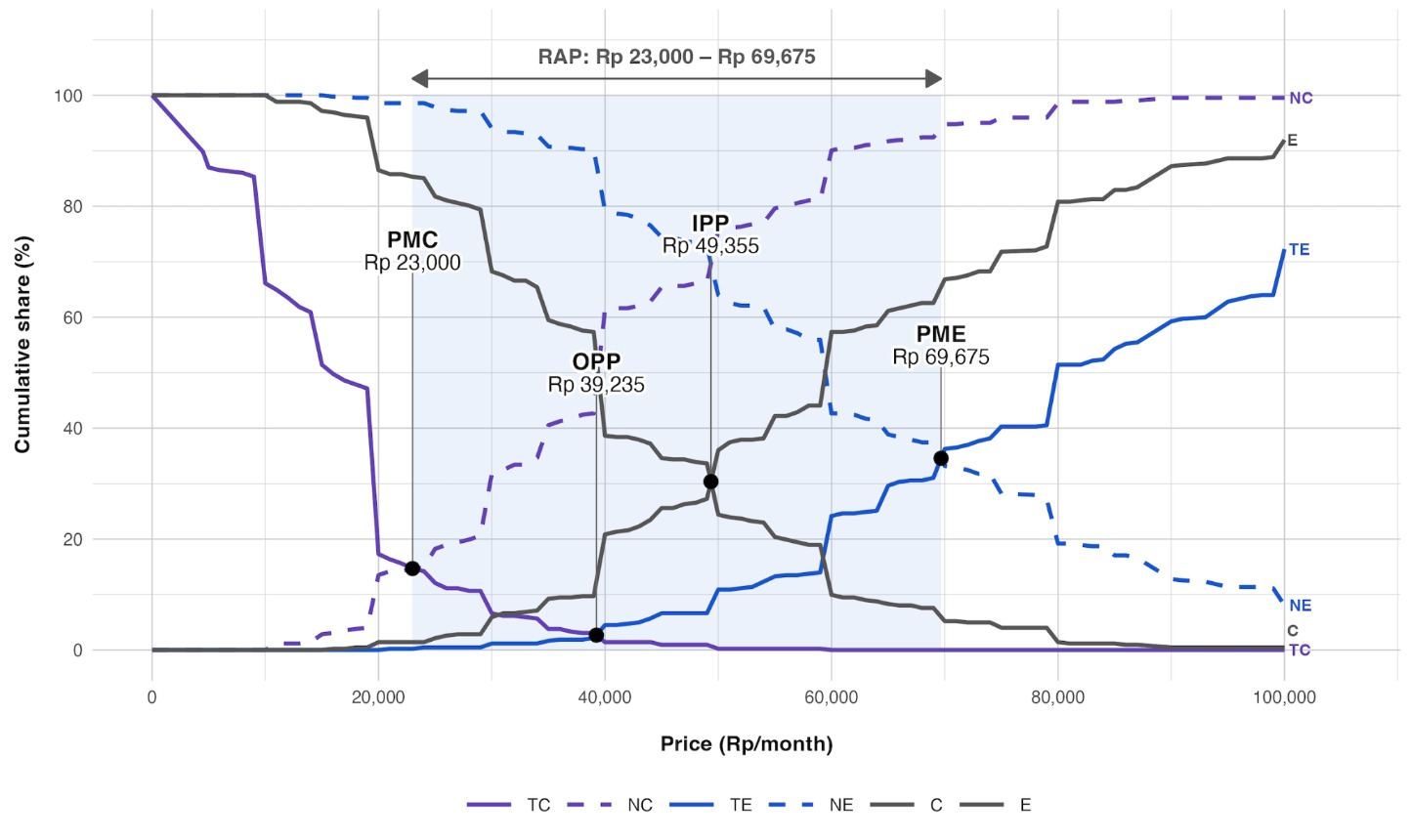
Readers accept anything from Rp 23,000 to Rp 69,675 a month. Resistance is lowest at Rp 39,235, and Rp 49,355 is where as many readers call the price cheap as call it expensive.
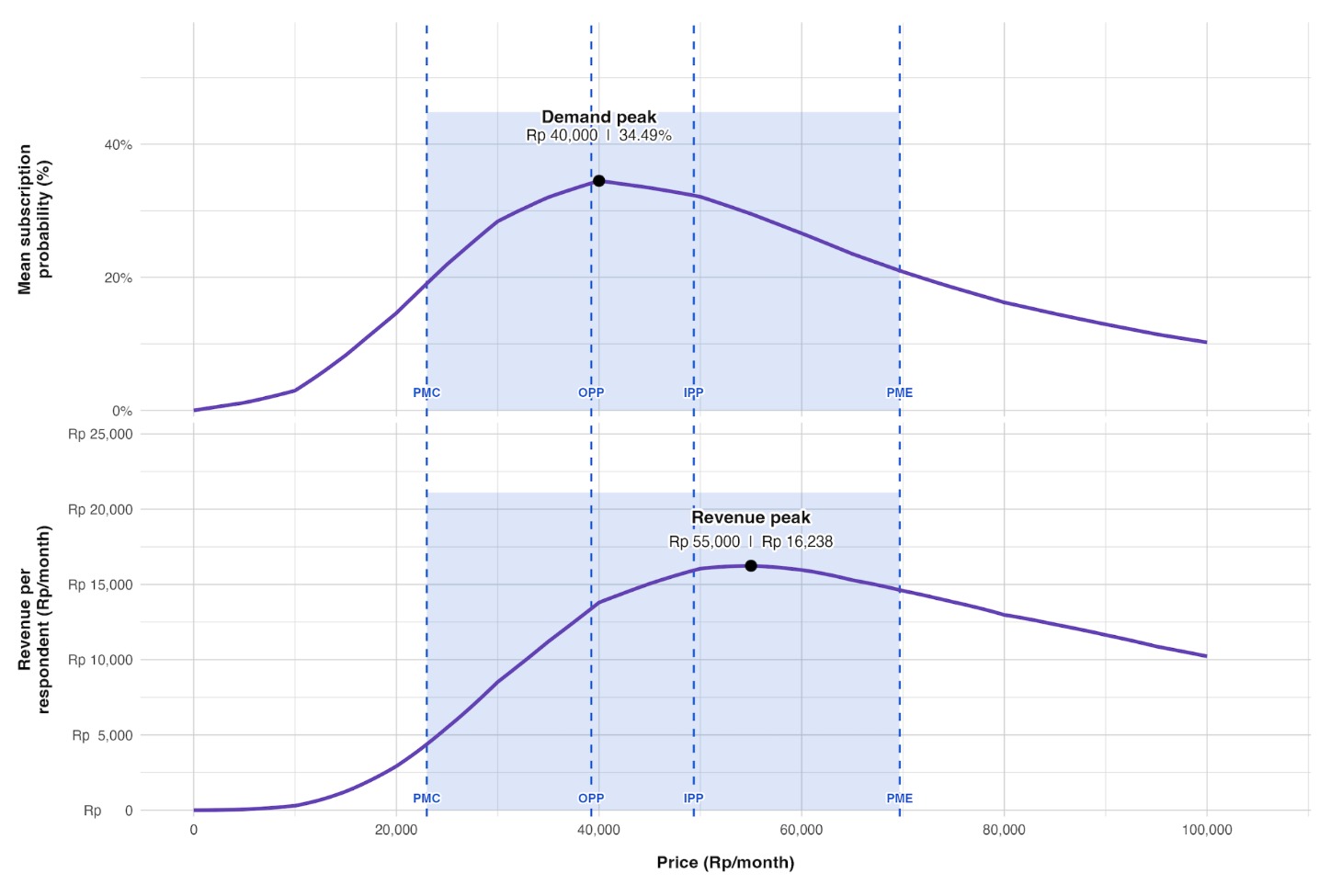
The NMS questions turn that range into demand. Likelihood to subscribe peaks at Rp 40,000 (34.49%); revenue per respondent peaks later, at Rp 55,000.
- Readers will pay a premium. The top of the acceptable range (Rp 69,675) is above the dearest content-led competitor, and readers leave more room above the least-resistance price than below it.
- Few readers expect it to be free. About 90% gave a reference price above zero. The research literature expected existing readers to anchor at zero; they compared Algo with paid rivals instead.
- Two methods agreed. The NMS demand peak sat just Rp 765 (1.95%) above the PSM optimal price, which is why I trusted the Rp 40,000 figure.
- Engagement decides who pays. Highly engaged readers peaked at Rp 50,000. Among rare readers, 24.3% priced it at zero, so they are not a launch target.
- Students need a lower price. Full-time students peaked at Rp 35,000 with an optimal price of Rp 36,000, which set the student rate.
The subgroups showed who carries the revenue, and who needs a lower price.
| Subgroup | n | Cheap intent | Expensive intent | Demand peak (Rp) | Peak reach |
|---|---|---|---|---|---|
| All respondents | 422 | 4.44 | 2.73 | 40,000 | 34.49% |
| Engagement | |||||
| High | 199 | 4.80 | 3.14 | 50,000 | 39.30% |
| Mid | 150 | 4.40 | 2.67 | 40,000 | 35.81% |
| Low | 70 | 3.57 | 1.76 | 30,000 | 27.59% |
| Status | |||||
| Full-time student | 105 | 4.59 | 1.68 | 35,000 | 33.56% |
| Studying and working | 93 | 4.70 | 2.43 | 40,000 | 38.84% |
| Working professional | 173 | 4.59 | 3.77 | 50,000 | 40.75% |
| Age | |||||
| 18–24 | 154 | 4.59 | 1.76 | 35,000 | 32.63% |
| 25–34 | 158 | 4.64 | 3.22 | 45,000 | 38.63% |
| 35–44 | 80 | 4.25 | 3.76 | 50,000 | 40.36% |
Highlighted: the prices that set the recommendation. Intent scores are the average stated likelihood to subscribe at the price each reader called cheap, and at the price they called expensive.
| Subgroup | n | PMC | OPP | IPP | PME | Range | Too cheap at Rp 0 |
|---|---|---|---|---|---|---|---|
| All respondents | 422 | 23,000 | 39,235 | 49,355 | 69,675 | 46,675 | 10% |
| Engagement | |||||||
| High | 199 | 28,345 | 40,000 | 54,357 | 79,147 | 50,802 | 4.5% |
| Mid | 150 | 23,250 | 39,125 | 48,552 | 71,889 | 48,639 | 10% |
| Low | 70 | 18,480 | 25,000 | 38,154 | 56,000 | 37,520 | 24.3% |
| Status | |||||||
| Full-time student | 105 | 19,789 | 36,000 | 39,556 | 59,231 | 39,442 | 12.4% |
| Studying and working | 93 | 20,000 | 35,000 | 49,364 | 74,714 | 54,714 | 7.5% |
| Working professional | 173 | 28,692 | 44,500 | 55,000 | 79,382 | 50,690 | 6.9% |
| Age | |||||||
| 18–24 | 154 | 19,695 | 29,857 | 39,857 | 59,550 | 39,855 | 15.6% |
| 25–34 | 158 | 28,000 | 42,000 | 51,667 | 78,345 | 50,345 | 4.4% |
| 35–44 | 80 | 28,545 | 43,000 | 56,000 | 79,263 | 50,718 | 6.2% |
PMC point of marginal cheapness · OPP optimal price · IPP indifference price · PME point of marginal expensiveness. All prices in Rp a month; range = PME − PMC. Highlighted: the overall optimal price, the students' optimal price behind the student rate, and the share of readers pricing it at zero in the most and least engaged groups.
Highly engaged readers and working professionals peak at Rp 50,000. Full-time students and 18–24s peak at Rp 35,000, and students' optimal price is Rp 36,000, which is why the student rate sits at Rp 35,000.
Recommendations
A starting price structure for Algo to consider before it launches. It covers running costs in every scenario I tested.
- Launch at Rp 40,000 a month, as freemium. Exclusive Research becomes paid; Market Insights and the newsletter stay free. I ruled out three alternatives: pricing below Rp 39,235 (unnecessary, and a shock at renewal), the Rp 55,000 revenue peak (lower intent, and above the competitor range), and the Rp 49,355 reference price (too steep for a new entrant, with no room to raise it later).
- Offer a 12.5% verified-student rate of Rp 35,000. Students check in with a university email. The rate also covers students who work: Algo gives up Rp 5,000 a subscriber in exchange for one simple check.
- Break even at 503–575 subscribers. That is 13.2–15.1% of the newsletter base, before counting Algo's roughly 134,000 Instagram followers.
GoalsFor Algo Research
ResultsFrom the study
A launch price Algo could defend against established titles
Rp 40,000/moRp 5,000 below Bisnis.com, at the point of least price resistance
A student offer that doesn't lose money
12.5% offEven if every subscriber took it, break-even only rises by 1.9 points
How many subscribers cover the running costs
503–57513.2–15.1% of the 3,802 newsletter base
The break-even range sits 19.4 points below the 34.49% stated intent at Rp 40,000. That gap is the margin for people saying they will pay and then not paying.
Reflection
What I learned
Test the survey before it tests you.
Seventeen pilot responses changed the design. Without them, the one gate I thought was harmless would have removed exactly the readers the lower price bound depends on.
Two methods agreeing is worth more than one precise number.
PSM and NMS land within Rp 765 of each other. That agreement did more to convince the client than either curve on its own.
What I would do next.
Stated prices are not paid prices. If Algo goes ahead, I recommended a Gabor-Granger test between Rp 39,235 and Rp 49,355 within six to twelve months of launch, and tracking churn separately for students by month three.